
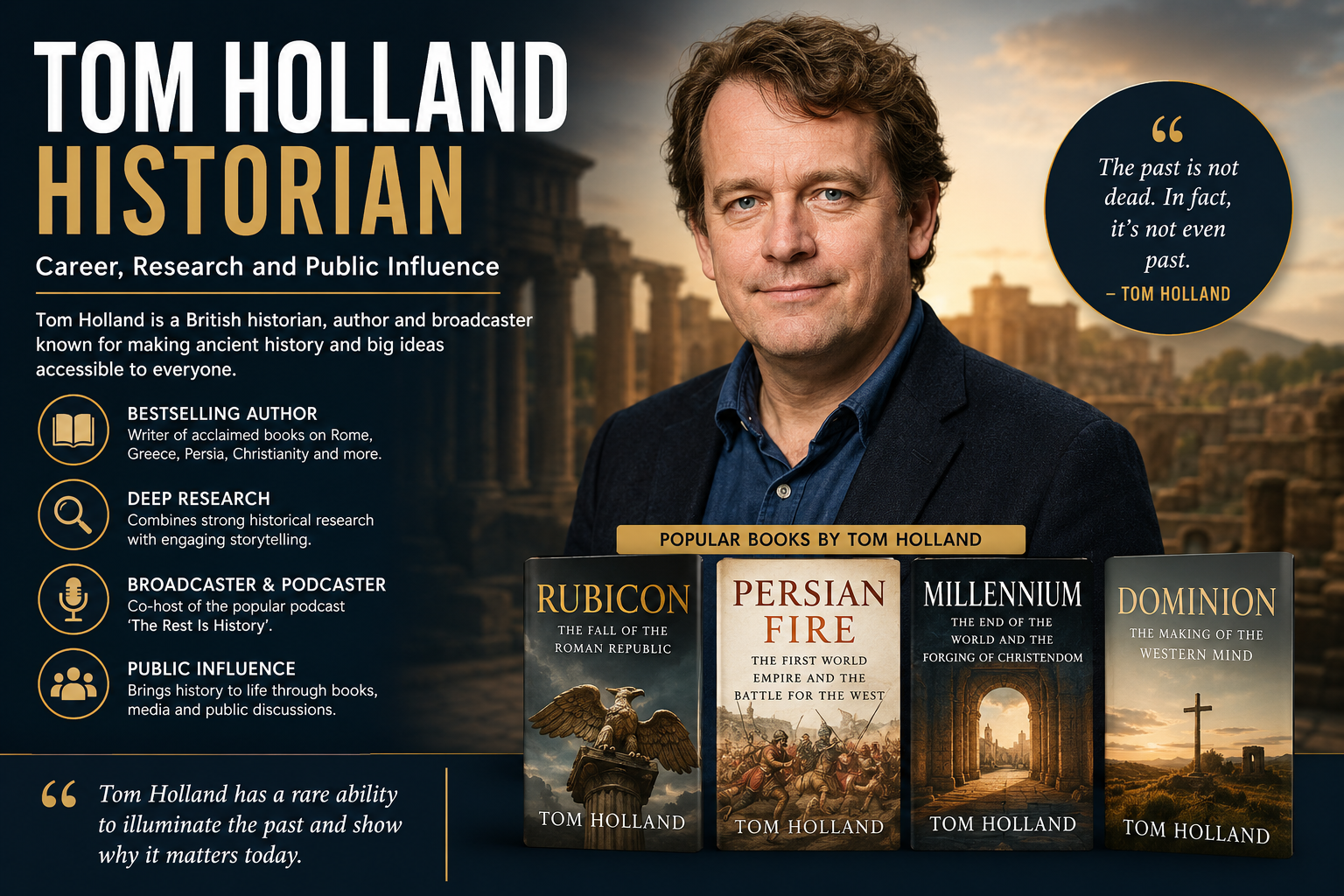
Who Is Tom Holland Historian?
Tom Holland is a British historian, author, translator and broadcaster known for writing accessible books about ancient and medieval history. He has gained recognition for explaining historical events through narrative-driven storytelling rather than purely academic analysis.
His work often focuses on:
- Ancient Rome
- Greek civilisation
- Persian history
- Christianity
- Islamic history
- Western political culture
tom holland historian is particularly known for making history feel relevant to modern audiences. Instead of presenting historical facts in a dry format, he explains how past events continue to influence politics, religion and society today.
Early Life and Education
Tom Holland was born in the United Kingdom and developed an interest in classical history at an early age. He studied English and Classics at university, where he deepened his understanding of ancient literature and historical interpretation.
His educational background played a major role in shaping his writing style. Rather than focusing only on academic theory, he became interested in storytelling traditions from the ancient world. This later became one of the defining features of his historical writing.
Before becoming widely recognised as a historian, Holland initially worked as a novelist and translator. These early experiences helped him develop the narrative skills that would later distinguish his historical books from more traditional academic works.
How Tom Holland Began His Career
Tom Holland’s early career included writing fiction inspired by historical themes. However, he eventually shifted towards non-fiction history writing, where he found a larger audience.
His breakthrough came with books that explored ancient Rome and classical civilisation in a highly readable format. Readers appreciated his ability to explain political conflict, military expansion and cultural transformation in a way that felt dramatic and engaging.
Several factors helped build his reputation:
| Career Element | Impact |
|---|---|
| Narrative storytelling | Made history accessible |
| Deep historical research | Increased credibility |
| Public speaking and broadcasting | Expanded audience reach |
| Podcasts and media appearances | Built modern relevance |
| Cross-disciplinary themes | Attracted wider readership |
His ability to combine historical accuracy with compelling storytelling allowed him to stand out in a competitive publishing market.
Major Books by Tom Holland Historian
Rubicon
One of Tom Holland’s most recognised works is Rubicon, a book exploring the fall of the Roman Republic.
The book focuses on:
- Julius Caesar
- Roman political corruption
- Civil war
- The collapse of republican government
- The rise of imperial rule
Readers often praise the book for making Roman history feel immediate and dramatic.
Persian Fire
In Persian Fire, Tom Holland examines the conflict between Greece and the Persian Empire.
The book highlights:
- Ancient warfare
- Greek city-states
- Persian expansion
- Cultural identity
- The origins of Western political ideas
It helped broaden his audience beyond Roman history enthusiasts.
Millennium
This work explores Europe during the first millennium and examines how religion, politics and violence shaped medieval civilisation.
Key themes include:
- Christianity
- Social transformation
- Political instability
- Cultural change
The book demonstrates Holland’s interest in connecting historical periods to modern society.
Dominion
Dominion became one of tom holland historian’s most influential books. It explores how Christianity shaped Western values, ethics and institutions over centuries.
Topics include:
- Human rights
- Morality
- Political ideals
- Equality
- Cultural identity
The book generated significant public discussion because it connected ancient religious developments with modern social values.
Tom Holland’s Research and Writing Style
Why Is Tom Holland Historian Popular?
One major reason for his popularity is his writing style. Many history books struggle to maintain reader engagement, but Tom Holland combines scholarship with narrative techniques commonly found in novels.
His writing style includes:
- Strong storytelling
- Clear explanations
- Historical context
- Character-driven narratives
- Accessible language
This makes his work appealing to both academic readers and general audiences.
Use of Historical Sources
tom holland historian relies heavily on classical texts, historical documents and archaeological evidence. However, he presents these materials in a simplified and engaging format.
Rather than overwhelming readers with academic terminology, he focuses on explaining why historical events mattered and how they changed societies.
Balancing Entertainment and Accuracy
A common challenge for public historians is balancing readability with factual accuracy. Tom Holland is often praised for making history entertaining without abandoning serious research.
His books generally avoid sensationalism while still maintaining narrative momentum.
Public Influence and Media Presence
Podcasts and Broadcasting
Tom Holland has expanded his influence through podcasts, radio appearances and television documentaries.
One of his most notable projects is The Rest Is History, a popular history podcast co-hosted with historian Dominic Sandbrook. The podcast discusses historical events, political developments and cultural topics in an accessible conversational style.
The success of the podcast demonstrates how digital media has changed the way audiences consume historical content.
Television and Public Discussions
Tom Holland historian has also appeared in documentaries and public debates covering topics such as:
- Ancient Rome
- Religion
- Western civilisation
- Political history
- Historical myths
His ability to communicate clearly has made him a recognised public intellectual beyond academic circles.
Why Readers Connect With Tom Holland Historian
Accessible History Writing
Many readers appreciate that Holland avoids overly technical academic language. His books are suitable for:
- Students
- Casual readers
- History enthusiasts
- Podcast listeners
- Researchers seeking introductory material
This broad accessibility contributes to his continuing popularity.
Relevance to Modern Society
Another reason readers connect with his work is the modern relevance of his themes.
For example, his discussions of:
- Political collapse
- Religious influence
- Social conflict
- Cultural identity
- Power structures
often resonate with current global issues.
Strong Narrative Structure
Tom Holland historian structures historical events like compelling stories. This approach helps readers emotionally connect with historical figures and events.
Instead of simply listing dates and facts, he explains motivations, conflicts and consequences.
Criticism and Academic Debate
Like many public historians, Tom Holland has also faced criticism from some academic historians.
Common critiques include:
- Simplifying complex historical debates
- Emphasising narrative over academic detail
- Drawing broad cultural conclusions
- Interpreting religion through modern perspectives
However, supporters argue that his work successfully introduces history to wider audiences who might otherwise avoid academic books entirely.
This debate highlights an important question within modern history writing: should historians prioritise academic precision or public accessibility?
Tom Holland historian attempts to balance both.
Tom Holland’s Role in Modern Historical Writing
The Rise of Popular History
Tom Holland represents a broader trend toward popular history writing. Modern readers increasingly prefer books and media that explain history in engaging ways.
This shift has created opportunities for historians who can communicate effectively across multiple platforms.
Influence on Younger Audiences
Through podcasts, interviews and social media discussions, Tom Holland has helped attract younger audiences to historical subjects.
Many readers discover his books after listening to podcasts or online discussions about Rome, religion or political history.
Encouraging Historical Curiosity
One of Holland’s greatest contributions may be encouraging people to explore history independently.
Readers often use his books as starting points before moving into deeper academic research.
Key Lessons From His Career
Tom Holland historian offers several useful lessons for writers, researchers and educators.
1. Complex Topics Can Be Accessible
Good communication matters. Historical ideas do not need to be overly complicated to remain valuable.
2. Storytelling Improves Learning
People remember narratives more effectively than isolated facts.
3. Public Engagement Matters
Historians can reach broader audiences through podcasts, interviews and media appearances.
4. History Remains Relevant
Modern political and cultural debates are often shaped by historical developments.
5. Balance Is Important
Successful history writing requires both strong research and engaging presentation.
How Tom Holland Historian Compares to Other Public Historians
| Historian | Known For | Writing Style |
|---|---|---|
| Tom Holland | Ancient history and religion | Narrative and accessible |
| Mary Beard | Roman civilisation | Academic but approachable |
| Simon Schama | Cultural history | Literary and reflective |
| Niall Ferguson | Economic and political history | Analytical and broad-ranging |
| Dan Jones | Medieval history | Fast-paced storytelling |
This comparison shows how Tom Holland historian occupies a unique space between scholarship and mainstream communication.
What Can Readers Learn From Tom Holland’s Books?
Readers often gain:
- Better understanding of ancient civilisations
- Knowledge of political systems
- Insight into religious influence
- Awareness of cultural continuity
- Historical perspective on modern issues
His books are especially valuable for readers interested in understanding how historical events continue to influence modern Western society.
Conclusion
Tom Holland historian has become one of the most recognised public historians in the English-speaking world. Through books, podcasts, documentaries and public discussions, he has helped make history more accessible to modern audiences.
His success comes from combining serious historical research with engaging storytelling. Rather than limiting history to academic institutions, he presents it as something relevant, dynamic and deeply connected to modern life.
Although debates about interpretation and accessibility continue within academic history, Tom Holland’s influence on public historical understanding is undeniable. His work encourages curiosity, critical thinking and greater appreciation for the forces that shaped human civilisation.
For readers interested in ancient history, political change, religion or cultural development, his books provide an informative and engaging starting point.
About the Author